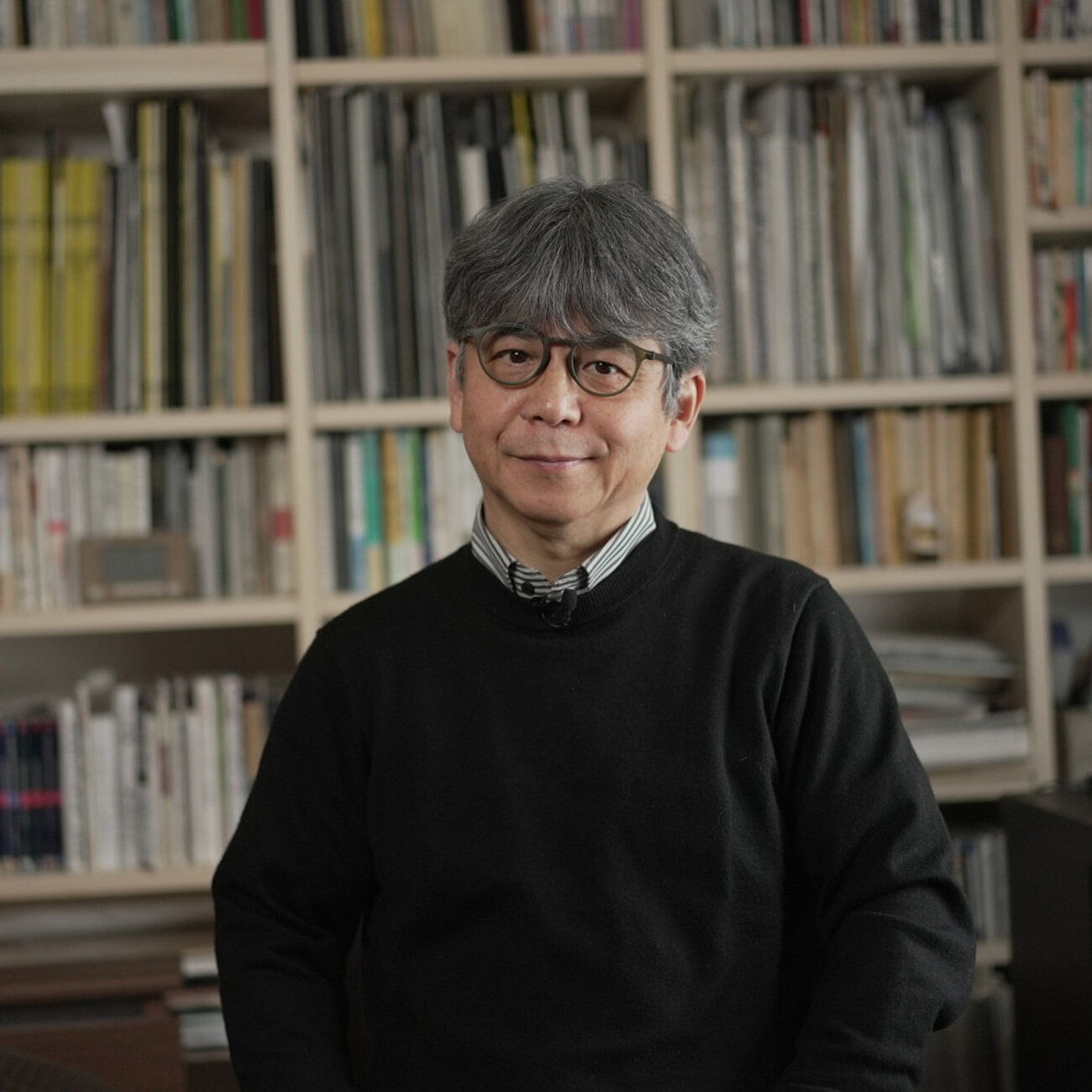
Toshio Hosokawa, Japan’s pre-eminent living composer, creates his distinctive musical language from the fascinating relationship between Western avant-garde art and traditional Japanese culture. His music is strongly connected to the aesthetic and spiritual roots of the Japanese arts (such as calligraphy), as well as to those of Japanese court music (such as Gagaku). He gives musical expression to notions of beauty rooted in transience: “We hear the individual notes and appreciate, at the same time, the process of how the notes are born and then die: a sound landscape of continual ‘becoming’ that is animated in itself.”
Born in Hiroshima in 1955, Toshio Hosokawa came to Germany in 1976, where he studied composition with Isang Yun, Brian Ferneyhough, and later, Klaus Huber. Although his initial compositions drew inspiration from the Western avant-garde, he gradually built a new musical world between East and West. He first gained widespread recognition with the 2001 world premiere of his oratorio Voiceless Voice in Hiroshima.
Toshio Hosokawa has written numerous orchestral works in recent years, including After the Storm for two sopranos and orchestra on the occasion of the 50th anniversary of the Tokyo Metropolitan Symphony Orchestra, and Woven Dreams, commissioned as part of the Roche Commissions (Cleveland Orchestra, Franz Welser-Möst, Lucerne Festival 2010). Circulating Ocean, premiered by the Vienna Philharmonic at the Salzburg Festival in 2005, has also become part of the repertoire of many orchestras. Toshio Hosokawa continues to compose works that focus on nature themes, such as the horn concerto Moment of Blossoming for Stefan Dohr and the Berlin Philharmonic (2011). Since 2003, he has been composing a loose sequence entitled Voyages for solo instrument and ensemble. In some of these works he combines Japanese and European instruments, as in Voyages X Nozarashi for shakuhachi and ensemble. Traditional Japanese instruments such as the shō or koto also feature elsewhere in his oeuvre, which comprises some 200 compositions.
The organ concerto Umarmung, premiered in 2017 by Christian Schmitt and the Bamberg Symphony Orchestra, was performed by the ORF Radio Symphony Orchestra Vienna at the Vienna Konzerthaus in 2018 and again at Suntory Hall in 2019. The orchestral work Uzu, premiered in 2019 by the Tokyo Metropolitan Orchestra, received the Otaka Prize for the best Japanese composition of the year. It was last heard in February 2024 as a Dutch premiere with the Antwerp Symphony Orchestra under Jun Märkl. In 2021, his violin concerto Genesis for soloist Veronika Eberle, a commission from the Hamburg Philharmonic State Orchestra, Hong Kong Sinfonietta, NHK Symphony Orchestra, Hiroshima Symphony Orchestra, Prague Radio Symphony Orchestra (SOČR), and the Grafenegg Festival, was premiered in Grafenegg.
In 2022, the world premiere of Ceremony for flute and orchestra, played by Emmanuel Pahud with the Tonhalle Orchestra under Paavo Järvi, caused a storm of enthusiasm in Zurich. The Japanese premiere took place with the Orchestra Ensemble Kanazawa under Nodoka Okisawa; the German premiere followed in February 2024 with the Bamberg Symphony Orchestra under Kent Nagano and soloist Daniela Koch. The Berlin Philharmonic Orchestra under Paavo Järvi premiered the violin concerto Prayer together with soloist Daishin Kashimoto in March 2023, followed by the Swiss premiere with the Lucerne Symphony Orchestra under Michael Sanderling and the Japanese premiere with the Yomiuri Nippon Symphony Orchestra and Sebastian Weigle. The British premiere took place in February 2024 at the Barbican Centre in London with the BBC Symphony Orchestra under Kahchun Wong with violinist Sayaka Shoji. For the Music for Vilnius project to mark the city's 700th anniversary, Toshio Hosokawa wrote Vilnius Invisible Angels for violin and accordion. He returned to Vilnius in autumn 2023 as a guest composer at the Gaida Festival. Highlights of the last season include the Japanese premiere of his work Texture at the Tokyo Opera City Concert Hall by the Philharmonic Octet Berlin, as well as the world premiere of the piano quintet Oreksis to mark the 50th anniversary of the Arditti Quartet at the Pierre Boulez Saal Berlin. In May 2024, the Kammerakademie Potsdam premiered In the Forest for chamber orchestra under Bas Wiegers.
The current season is centred around creating his new opera Natasha, which is due to premiere in August 2025 at the New National Theatre under the direction of Kazushi Ono with the Tokyo Philharmonic Orchestra in a production by Christian Räth; the multilingual libretto was written by the Berlin-based Japanese writer Yoko Tawada. As composer-in-residence, Toshio Hosokawa will also be a guest of the Valencia Orchestra, which will dedicate two concerts to him under its chief conductor Alexander Liebreich; among other works, the violin concerto Genesis with Veronika Eberle and the one-act melodrama Futari Shizuka (The Maiden from the Sea) will be performed. A short solo piece will be created for the Stuttgart University of Music's guitar competition, and another solo work for violinist Francesco D'Orazio will be premiered at the Teatro Argentina in Rome in May 2025.
Many of Toshio Hosokawa's music theatre works are now part of the repertoire of major opera houses. His first opera Vision of Lear, which was received with great praise at the 1998 Munich Biennale, was followed in 2004 by Hanjo, a work staged by choreographer Anna Teresa de Keersmaeker and co-commissioned by the Brussels opera house La Monnaie and the Aix-en-Provence Festival. It has since been performed on numerous stages, most recently in 2022 as the American premiere at the Catapult Opera in New York with the Talea Ensemble and in 2023 in a further production with choreography by Sidi Larbi Cherkaoui at the Bavarian State Opera. The opera Matsukaze, which, like Hanjo, is based on material from Japanese Nô theatre, will be performed there again in 2025 as part of the Ja, Mai festival. The work, which has since been performed many times, was first staged by choreographer Sasha Waltz at La Monnaie opera house in Brussels in 2011. The monodrama The Raven for mezzo-soprano and ensemble, premiered in Brussels in 2012, was also staged in several theatrical performances.
In quick succession, Toshio Hosokawa has presented three more operas: Stilles Meer debuted at the Hamburg State Opera in 2016, the one-act melodrama Futari Shizuka (The Maiden from the Sea) premiered in Paris in 2017 and was followed in 2018 by Erdbeben. Träume at Stuttgart Opera, based on a libretto by Büchner Prize winner Marcel Beyer. The musical material of the opera was used to create the four-movement orchestral suite Erdbeben. Träume, which was premiered in November 2022 by the Orchestra del Teatro Comunale di Bologna under Marco Angius and whose revised version was first performed by the Hamburg Symphony Orchestra under Sylvain Cambreling at the Elbphilharmonie in 2023. In 2021, the musical fairy tale Deine Freunde aus der Ferne, in which Toshio Hosokawa and writer Yoko Tawada take the young audience on a dream journey to distant worlds, was launched at the Philharmonie Luxembourg by the ensemble United Instruments of Lucilin and narrator Salome Kammer.
Toshio Hosokawa has received numerous awards and prizes. He has been a member of the Academy of Fine Arts Berlin since 2001 and was a fellow of Berlin’s Institute for Advanced Study in 2006/7 and 2008/9. In 2013/14 he was composer in residence at the Netherlands Philharmonic Orchestra as well as at the Hiroshima Symphony Orchestra from 2019 till 2021. In 2018 he received the Japan Foundation award, and in 2021 he was awarded the Goethe Medal for his services to cultural exchange between Japan and Germany. He is artistic director of the Takefu International Music Festival and artistic director of the Suntory Hall International Program for Music Composition.
As of April 2025